
[#92] The road to neobanking in India leads through SFBs: Private Banks have baggage. WOS is rare. Everyone's converging to SFBs
Globally, fintechs across payments, lending, BNPL, and crypto are acquiring bank licenses. In India, the path seems to be through bank mergers, with SFBs emerging but only ~9 realistic targets remain

Hey folks! Welcome back to The Painted Stork!
If you all read my last piece, which was on the great Indian fintech re-rating, it actually led me down a bunch of rabbit holes. And one of them, which was really interesting, was the concept of fintechs becoming banks.
And mind you, this isn’t just a case of fintechs who got their business model disrupted, and then pivoted to a bank (looking at Slice, with their Slice Small Finance Bank play, or BharatPe, which merged with Centrum to form Unity Small Finance Bank, which is actually an infra play for them, allowing them to provide the TPAP (onnectivity to NPCI rails) as a service, not just to its UPI App, but it also powers Jar’s UPI App, and Stashfin, a NBFC with a tech platform)
This is a global trend that we are seeing, across regions, and across scaled fintechs as well. These are profitable fintechs, which have also IPO’ed. This seems to be the next stage of evolution of fintechs. We’ve come full circle. I’d written a piece on this, from the other side → the banking perspective about 6 months ago, which you can check out below:
![[#78] Banking in India: FDI investment, bank consolidation, and the "great re-bundling"](https://substackcdn.com/image/fetch/$s_!Xe0Z!,w_140,h_140,c_fill,f_webp,q_auto:good,fl_progressive:steep,g_auto/https%3A%2F%2Fsubstack-post-media.s3.amazonaws.com%2Fpublic%2Fimages%2F800fcabe-2b7f-4397-8780-3456f829160a_1506x846.png)
But let’s look at the global pattern, where successful fintechs have become banks
The most successful fintechs globally have all made the same move, they went and got a bank.
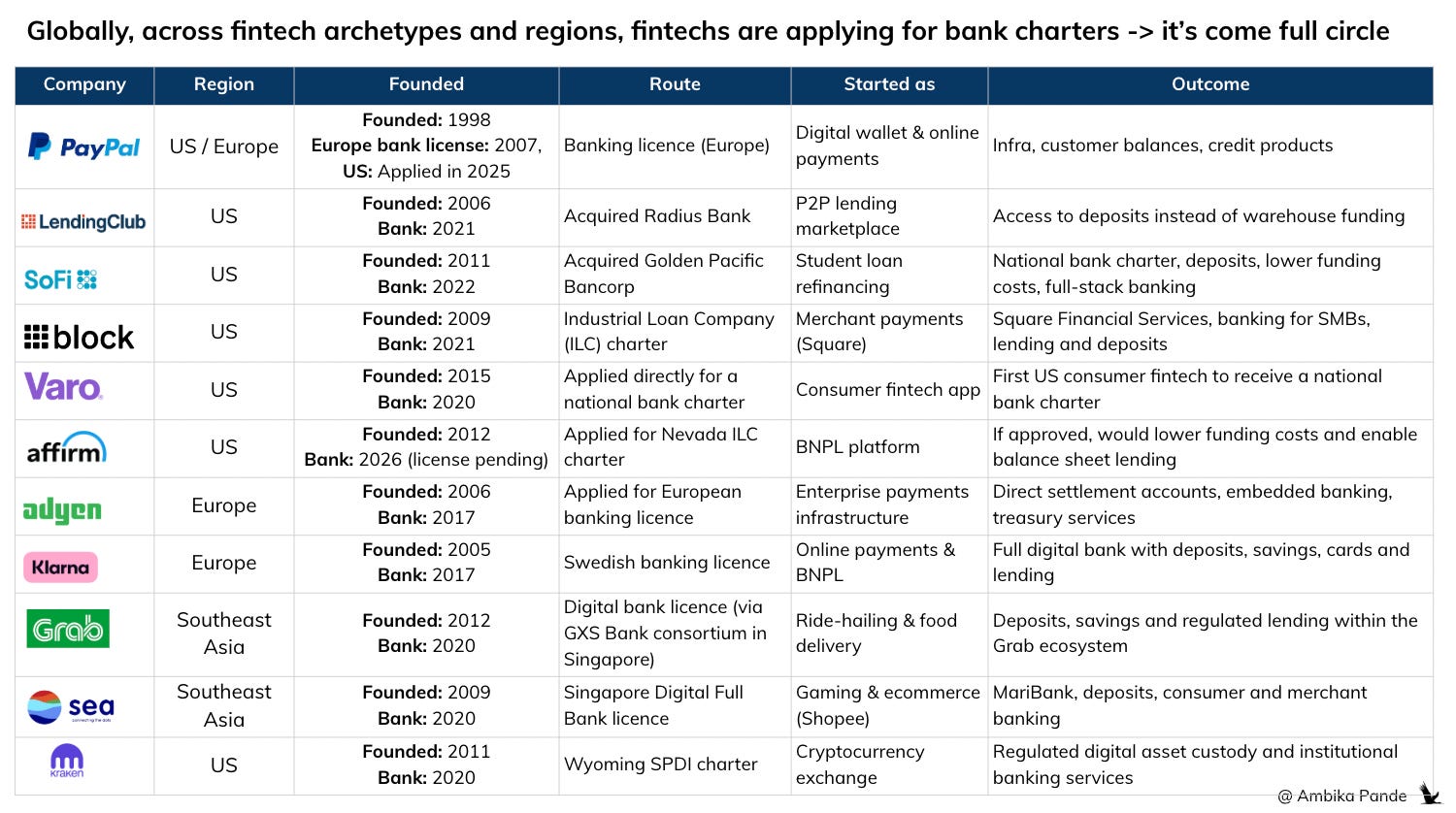
In South East Asia, the model seems a ‘super-app’ which could or could not be a fintech, and then going the digital banking way: Grab and SEA limited

Grab was founded in 2012, as a ride hailing and food delivery app. Banking has been a core strategy for it across South East Asia, with it going after banking licenses in Singapore, Malaysia, and Indonesia: the superapp → bank way.
→ Singapore: Grab applied for a new digital banking license via a consortium with Singtel, and then incorporated GXS bank, which is owned 50-50 by Grab and Singtel
→ Malaysia: Grab applied for a new digital banking license via a consortium with Grab, Singtel and Malaysian investors, and incorporated GXBank.
→ Indonesia: Grab bought into an existing bank - the Bank of Fama with Emtek, Singtel, and KakaoBank, which then got rebranded to SuperBank. Now, Grab is consolidating its stake more, through Singtel transferring its SuperBank stake to GXS Bank, which is owned 50-50 by Grab and Singtel. So, Grab now gets 50% ownership of Singtel’s original direct stake in SuperBank, via the GXS Bank, and while exact numbers are not disclosed, it is reported Grab's combined direct and indirect shareholding in Superbank will increase to over 50%

SEA Limited was founded in 2009 as an ecommerce and digital finance company. It operates 3 lines today:
Shopee: The e-commerce platform that was launched later in 2015 and grew into the largest marketplace in Southeast Asia and Taiwan.
Garena: The original digital entertainment and gaming division
Monee (formerly known as SeaMoney / Sea Digital Finance): The digital financial services arm that handles mobile wallets, digital banking, and payments
SEA has pursued a simliar strategy to Grab.
→ Singapore: Unlike Grab, did not apply via a consortium, but applied on its own. Awarded a Digital Full Bank (DFB) licence by the Monetary Authority of Singapore (MAS) in December 2020, Launched MariBank in 2023
→ Malaysia: Here, SEA did form a consortium with YTL Digital Capital (part of Malaysia’s YTL Group). The consortium won one of five digital bank licences from Bank Negara Malaysia in April 2022. The bank launched as Ryt Bank in 2025
→ Phillipines: SEA acquired 60% of in 2020 Banco Laguna, an existing rural bank, which rebranded to SeaBank Philippines in 2021. So, like Grab in Indonesia, this was an acquisition of an existing licensed bank, not a new digital banking licence
So in South East Asia, I have three observations:
The government clearly supports neobanks, and in the last 5 years, have been allowing applications for digital banking licenses
It isn’t just fintechs applying for neobanking licenses. It is also consumer apps. Clearly the SE Asia model of fintech is a super app strategy, which, unlike India, has been successful.
In South East Asia, it is a mixture of standalone fintechs / apps, or consortiums, that either apply for a new license, or buy into an existing one. The overall support of digital banks seems to be universal, and not specific to a certain type of fintech, or license acquisition strategy.
Let’s also take a look at US and EU players. We are seeing this fintech to bank evolution across sectors. It isn’t just restricted to one category of fintech
This is across payment aggregators, lending platforms, BNPL players , consumer fintechs, and even cryptocurrency players. Let’s look at them one by one.
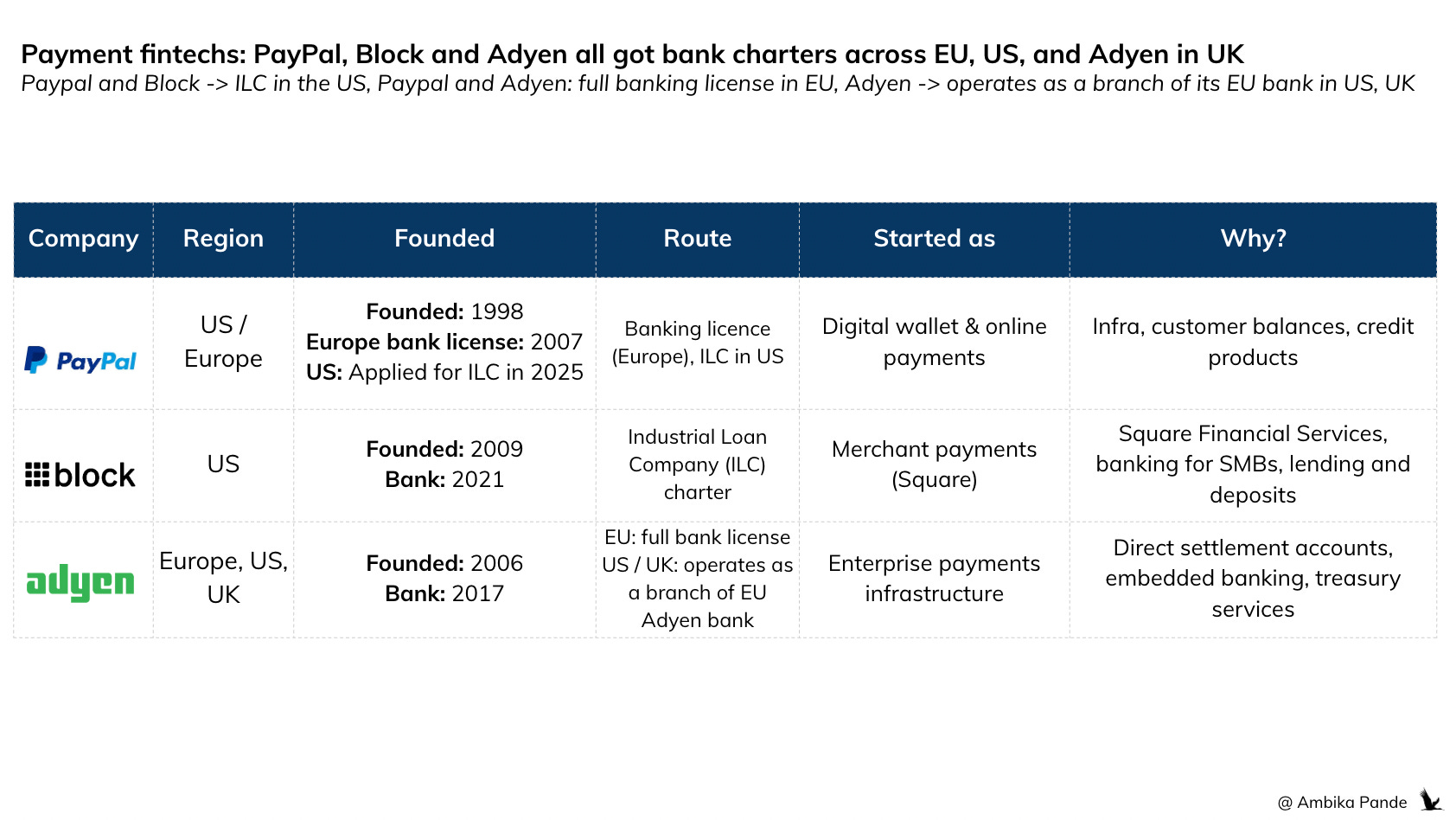
Payment Fintechs
Paypal: 1998 Founded: Started out as a digital wallet, and a P2P payment network, which went viral when eBay blew up. Then evolved into a full stack fintech, including payment acquiring services. 2005: Got a Europe banking license in Luxembourg December 2025, PayPal applied to the FDIC and the Utah Department of Financial Institutions to establish "PayPal Bank," a Utah chartered industrial loan company (ILC)
Block: 2009: Founded. Started as a P2P lending marketplace 2021: Got an ILC bank license (like what Paypal is applying for)
Adyen : 2006 Founded: Started as a payments infrastructure company (think payment aggregators): 2017: Got its first banking license granted by the Dutch Central Bank. As of 2023, it has 3 banking licenses. The EU one from the Dutch Central Bank, and licenses in UK and US which allow it to operate branches (as an extension of Adyen Bank in the Nederlands)
Lending platforms
Sofi: 2011 - Founded. Student loan refinancing platform 2022: Acquired Golden Pacific Bancorp, which is a National Bank, and can operate across the 50 states in the US.
LendingClub: 2006 - Founded as a P2P lending marketplace. 2021: Acquired Radius Bank, which is a National Bank
BNPL players
Affirm: 2012 - Founded. BNPL platform. 2026: Applied for Nevada ILC Banking charter (in progress)
Klarna: 2005 - Founded. BNPL platform. 2017: Acquired a full banking license in Sweden
Consumer fintechs
Varo: 2015 - Founded. Consumer fintech app. 2020 - Received a national bank charter; it applied in 2017.
Cryptocurrency players
Kraken: 2011 - Founded. A cryptocurrency exchange. 2020: Got a SPDI charter in Wyoming. a SPDI is a Special Purpose Depository Institution. and was created in 2019, specifically for companies dealing in cryptocurrency, digital asset custody, tokenized assets and stablecoins. This type of bank can HOLD funds, but cannot lend these funds. And hence, it makes sense for the category of fintechs described: they need to be able to hold fiat, to be able to exchange cryptocurrency for fiat or vice versa, instead of relying on partner banks.
There are different types of banks described above
National Bank: A federally chartered bank that can accept deposits, make loans, and offer the full suite of banking services nationwide. The choice between a national and state bank is primarily about the chartering authority and regulatory framework, not whether the bank can operate or serve customers nationwide. The biggest difference isn't what the bank can do, it's which regulator oversees it and which legal framework governs its operations (like SPDI in Wyoming, or ILCs allowed in certain states like Utah etc)
Industrial Loan Company (ILC): A state chartered bank that can take insured deposits and lend. Provides bank capabilities without subjecting the fintech parent to bank holding company regulation and its associated restrictions, which is why we’re seeing fintechs prefer this model.
Digital Banking License: A license for banks operating primarily through digital channels, with little or no physical branch network. Nubank. Revolut are examples of this.
SPDI (Special Purpose Depository Institution): A Wyoming chartered bank designed for digital asset businesses, providing custody and payment services without traditional lending. This is what Kraken has gotten.
We have also got core neobanks. So these aren’t fintechs with a core business that scaled, and then got a bank license. Their core business is banking.
Some examples are Revolut, Nubank, Kakaobank, Chime etc. I’ve talked about these in detail in previous articles, so I won’t go into them in detail. You can check out the below article.
But TLDR: Globally, neobanks have done well in areas where there is less banking or credit penetration - like in the case of LATAM. And of course, these are ‘fintechs’ with a ‘move fast and break things’ mindset, versus the more traditional slow moving banks, so they’ve been able to optimize customer onboarding, credit, and bundle services such as eSIMs, to scale their customer vase really fast.
And this isn’t just Europe, US, UK and LATAM by the way. As I talked about above, we’re seeing this trend of digital banks in South East Asia also.
[#40] The case for neobanks in India: what can we learn from global successes such as Nubank?
![[#40] The case for neobanks in India: what can we learn from global successes such as Nubank?](https://substackcdn.com/image/fetch/$s_!G8yT!,w_280,h_280,c_fill,f_webp,q_auto:good,fl_progressive:steep,g_auto/https%3A%2F%2Fsubstack-post-media.s3.amazonaws.com%2Fpublic%2Fimages%2F3d81c4d2-68c0-4341-8025-90f2bcf45e1e_1600x896.png)
Traditional banks are slow to innovate. This is a fact. And they’re slow with good reason: in the world of fintechs, with constant innovation, speed, and shipping products, sometimes it may be good to have an institution that moves slowly, and with temperance, especially since they’re the backbone of the financial industry.
In India’s version, the destination seems to be the same, where lead to banking, but the route is slightly different
India is slightly different. In South East Asia, regulators in Malaysia, Singapore, Indonesia and the Phillipines are granting either new digital banking licenses, or allowing standalone consumer apps (which may or may not be fintechs) to acquire existing banks.
In US, fintechs are being allowed to acquire national banks, or a specific type of bank such as a ILC, which is less regulated, but still allows lending etc. There are also specific classes of banks being created, such as the SPDI that serve new use cases and business models → cryptocurrency, digital asset custody etc.
In Europe, full banking licenses are given to fintechs. Klarna, Monzo, and Revolut. And the same in LATAM, with NuBank and Uala - major regional player operating in Argentina, Mexico, and Colombia
India’s regulators have chosen not to grant new banking licenses to fintechs. The RBI does not issue digital-only bank licenses.
The exception here is Paytm, which got a Payments Bank license, which is now, as all know cancelled as of April 24th 2026. Other ‘neobank’ like models that came up in 2016 - 2019 (Jupiter, Open, Fi) are struggling. Slice merged with a Small Finance Bank to become a bank itself.
That’s the interesting bit. Instead of issuing fresh licenses, RBI has allowed mergers with existing licensed entities to create Small Finance Banks.
This speaks also to the ‘consolidation’ theme I’ve talked about that is happening in the banking sector. There is a focus to consolidate the Regional Rural Banks (RRB)s, and the Urban Co-Operatives, and clean this space up, to provide smaller banks a better chance of survival and ease of governance. But more on that later.
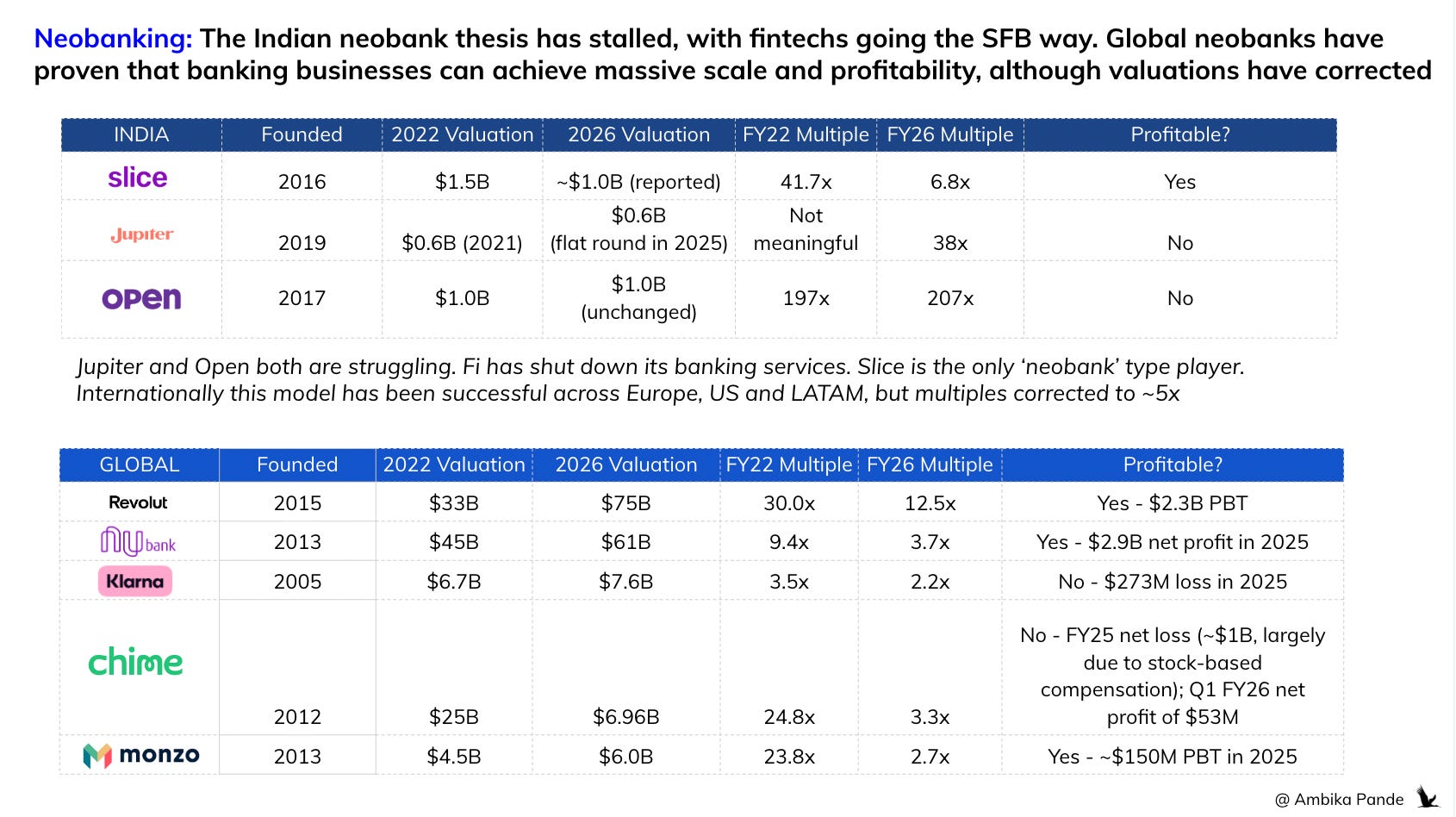
The ‘neobanks’ in India, created through SFB mergers.
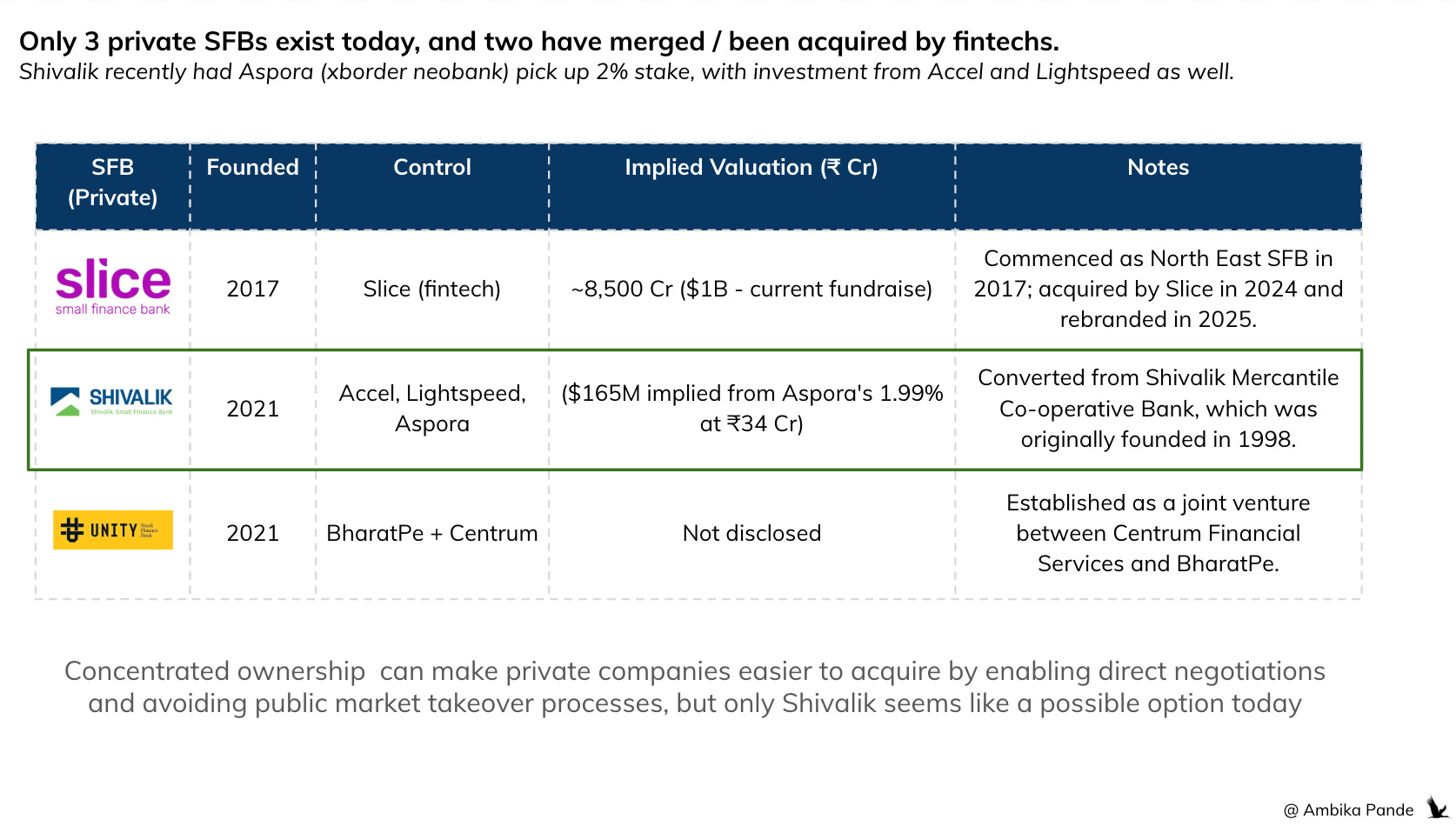
Slice: Started in 2016 as a BNPL platform. Merged with North East SFB (completed Oct 2024). Rebranded as Slice SFB in May 2025. First-ever fintech-bank merger in India. Reported first year of profitability in FY26. Currently raising $50-100M at a ~$1B valuation (~₹8,500 Cr). It’s ambition is to become India’s Nubank.
BharatPe + Centrum → Unity SFB: Formed in Nov 2021 from the reconstruction of the scandal hit Punjab & Maharasthra Cooperative Bank. BharatPe holds 49%, while Centrum holds 51%. Recently though, there has been some news of an ownership struggle between Centrum and BharatPe. BharatPe and Centrum co-acquired the failed PMC Bank (which was a UCB) in 2021, relaunching it as Unity Small Finance Bank. Now, Centrum wants to convert warrants from the original deal into shares - but this requires increasing the bank’s authorized capital (the legal cap on how many shares it can issue) from ₹4,000 Cr to ₹4,900 Cr. BharatPe, which can’t participate due to FEMA restrictions on foreign-owned entities, would see its stake diluted from 49% to ~21%. The Delhi High Court has sided with BharatPe for now, blocking the capital increase as a “reserved matter” requiring BharatPe’s consent under their shareholders’ agreement.
The neobanks that are now struggling.
Fi Money : Founded in 2019. Backed by Sequoia and Temasek, peaked at $522M valuation, 3.5M users. Shut down consumer banking entirely in March 2026. Pivoted to B2B AI. Worked as a wrapper around Federal Bank where Fi Money owned the customer, but used Federal Bank to create a bank account for the customer, and provide banking services. They raised $137M and still couldn’t make it work without owning the banking stack.
Jupiter: Founded in 2019. In talks since 2024 to acquire a 5-9% stake in SBM Bank India. Deal still pending RBI approval. Same structure as Fi.
Open: Founded in 2017. Struggling with the same structural problem.
Fi raised $137M and shut down. Jupiter and Open are still struggling, and probably will shut down, or get sold in a fire sale. Slice merged with a bank and turned profitable. That’s it. That’s the thesis.
So the trend is, you’ve got two fintechs, that have merged with an existing bank, and become a SFB for banking and infrastructure purposes.
Slice was a credit start-up, so the goal of being a bank obviously is also to lend.
And BharatPe / Unity SFB, apart from lending, is also providing payment infrastructure services - It is a UPI Payer TSP for Stashfin, Jar (the gold - fintech app), and its own app Bharatpe, which in simple terms means, it is the bank that provides connectivity for these apps to NPCI (since NPCI mandates that only banks can connect directly with UPI rails).
The Aspora - Shivalik SFB investment is another data point that points to the fintech - SFB merger.
Aspora, a Sequoia and Greylock-backed cross-border neobank for the Indian diaspora, acquired a 1.99% stake in Shivalik SFB for $3.3M (₹34 Cr) in July 2026, implying a $165M valuation for Shivalik.
What is Aspora? It’s a financial super-app for NRIs - remittances, mutual fund investments, and also building on stablecoin rails.Backed by Sequoia, Greylock, Y Combinator. $95M+ raised. It also provides NRI banking. So it’s essentially a cross border neobank. And it is choosing to anchor itself in an Indian banking license. Same logic as SoFi, Block, or Klarna. You own the stack, lower the cost of capital, and control the customer relationship end to end, not just the parts that are visible to the customer.
Shivalik itself is interesting - it converted from an urban cooperative bank in 2021. Already backed by Accel, Lightspeed, Quona Capital. SMBC Asia Rising Fund invested 4.99% in Aug 2025. It’s positioning itself as banking infrastructure for fintechs. And if the investors are anything to go by, they’re probably not going to be content with Shivalik remaining a SFB, and are planning for it to acquire a Universal Banking License, which RBI has put a path for. You can read about it here, but TLDR, apart from other requirements, a SFB needs to have 5 years of successful operations as SFBs, it needs to be listed on stock exchanges, and it’s net worth should be greater than INR 1,000 crore. At the very least, I expect an IPO happening soon.
Note: Aspora acquired a controlling stake in UAB Hokodo in July 2026. UAB Hokodo is a Lithuanian EMI (Electronic Money Institution), giving it a licensed entity to issue euro wallets/IBANs and process payments across all 27 EU countries, completing its UK-EU-UAE-India corridor.
So, if we go by global trends, and India trends, fintechs, to stay relevant, will have to become banks. Which then raises the question → how feasible is the market for this play?
Here’s every category of bank in India, and why most of them are irrelevant.
Public Sector Banks (12 banks here): Not Acquirable
These are government owned with FDI caps, and are under political control. Not for sale. So immediately we can rule these 12 banks out of the race.
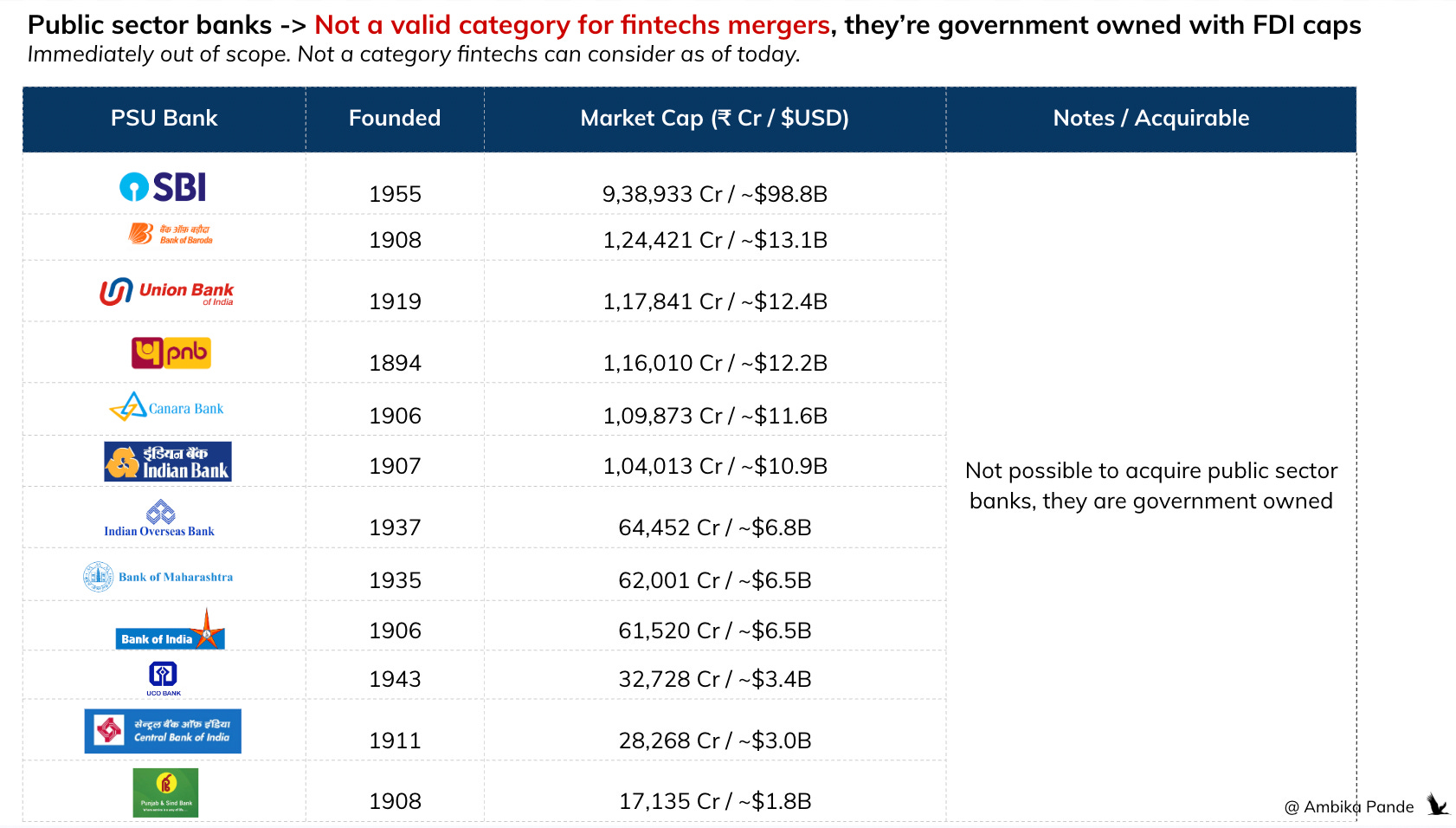
Even the smallest PSU bank (Punjab & Sind) is INR 17,000 Cr, and none are available for private acquisition. So this is completely out of scope.
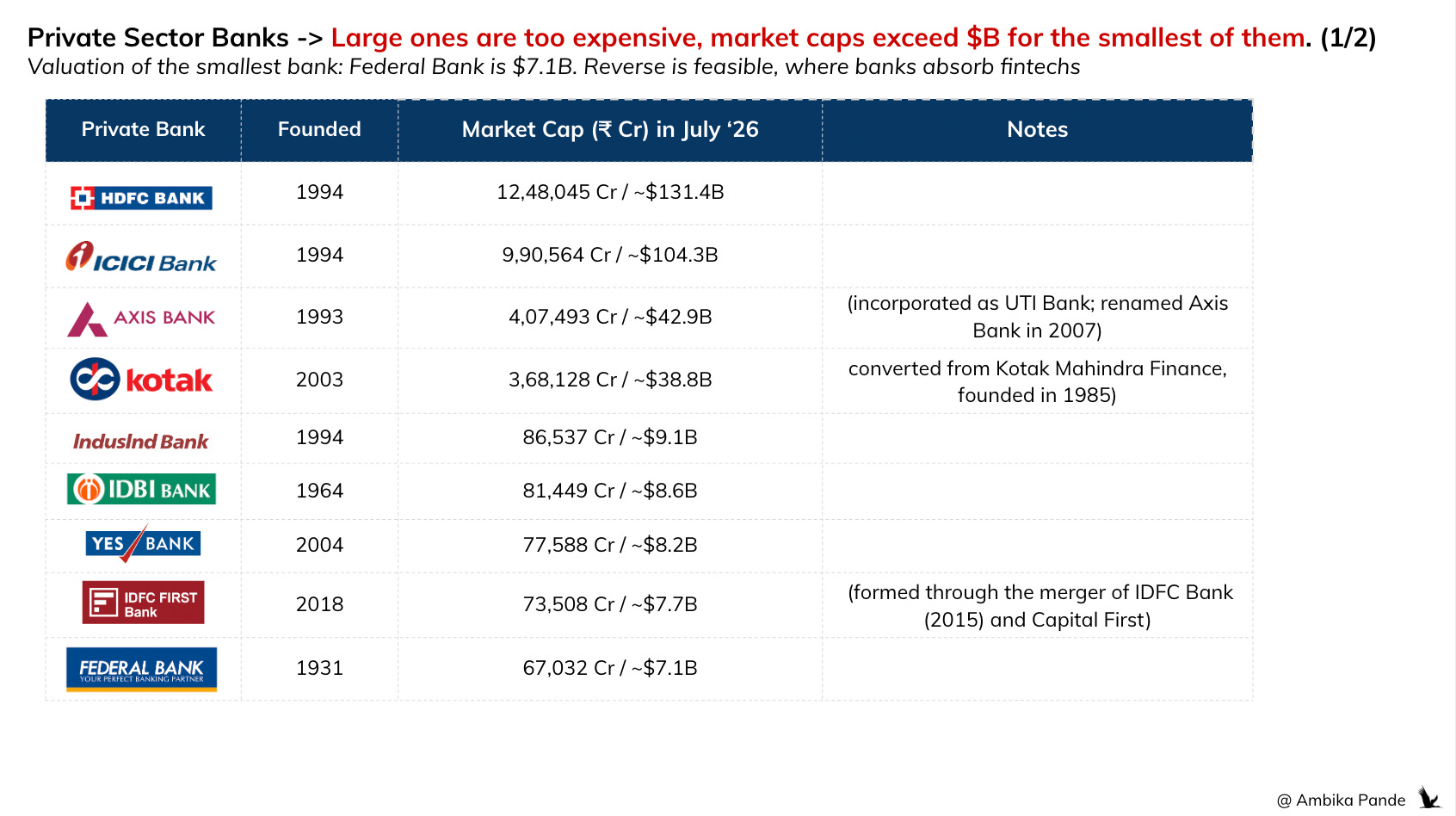
Private Sector Banks: The Large Banks (9 banks), Too expensive to make sense
The top 4 are in the tens of $Bs which make no sense. Completely out of reach. The mid-tier (IDBI, Federal, IndusInd, Yes, IDFC First) range from $7 - $9B, still far too expensive for any Indian fintech, and come with complex ownership structures, regulatory baggage, or ongoing restructuring.
IDBI is an interesting case - in 2019, IDBI Bank was in severe financial distress due to high NPAs, and so the government asked LIC to rescue the bank. LIC acquired a 51% controlling stake, while the Government of India retained about 46%. Because LIC, not the Government became the controlling shareholder, the RBI reclassified IDBI as a private sector bank, even though LIC itself is government-owned.
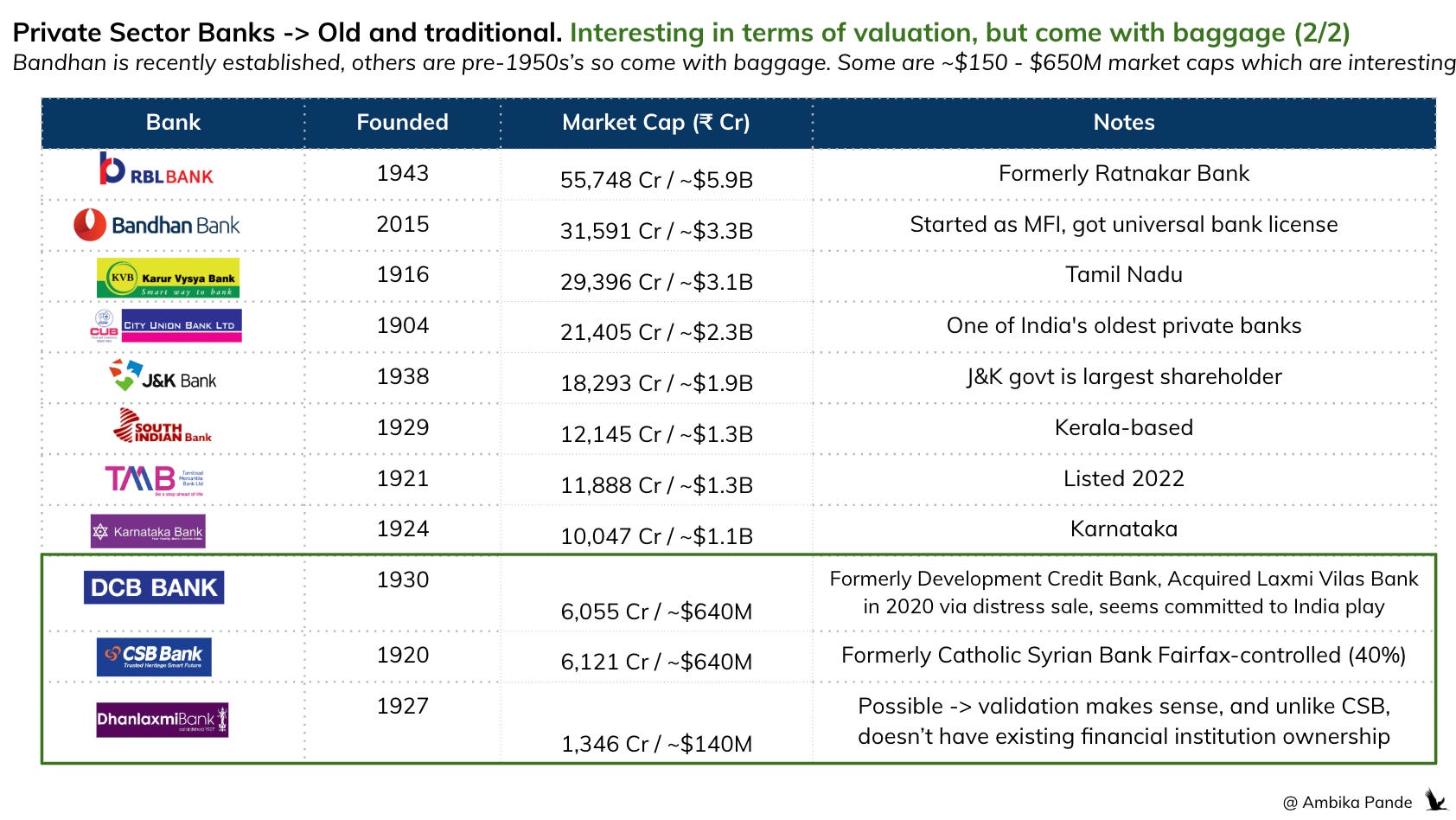
Private Sector Banks: Old/Traditional (12 banks), the Interesting middle
These are India’s heritage private banks. Most are regional, century-old institutions with modest market caps. This could be possible. On paper especially some of these looks affordable.
Dhanlaxmi ($140M market cap), DCB ($640M market cap), CSB ($640M market cap) are comparable to SFB valuations. In fact, CSB already is 40% owned by Fairfax, the Canadian conglomerate - and the deal happened in 2018. So there is precedence.
But there are some challenges from a fintech perspective.
Legacy baggage. Century-old banks come with legacy branch networks, old tech stacks, unionised workforces, and entrenched management. Integrating a digital-first model into a 1920s era bank is not that easy, and will require much more investment than simply just ‘acquiring’ the bank.
Promoter/regional control. Many are controlled by regional promoter groups, trusts, or state governments (J&K Bank). Hostile or even friendly acquisitions face political resistance.
And it takes years of investment.
Take CSB for example. While Fairfax India acquired control in 2018, and in its annual reports talks about how they’ve been investing in people, systems and technology to become a new age private sector bank, this has been a multi year process. In 2025 it migrated to a new core banking system, and is investing in new finance and risk platforms. Streamlining existing processes and systems is usually more painful than starting from scratch.
Bandhan is the exception. Started as an MFI, got a universal bank license directly from RBI in 2015. But RBI hasn’t issued a new universal bank license since (unless you count AU Small Finance Bank transitioning to a universal bank)
Bottom line: These banks are theoretically available but practically difficult. The few that are affordable (Dhanlaxmi really seems like the best bet, even DCB at a $640M market cap may be teetering on the expensive side) come with operational complexity that may make sense for conglomerates, but not for fintechs, especially when in India, there is a profitability struggle.
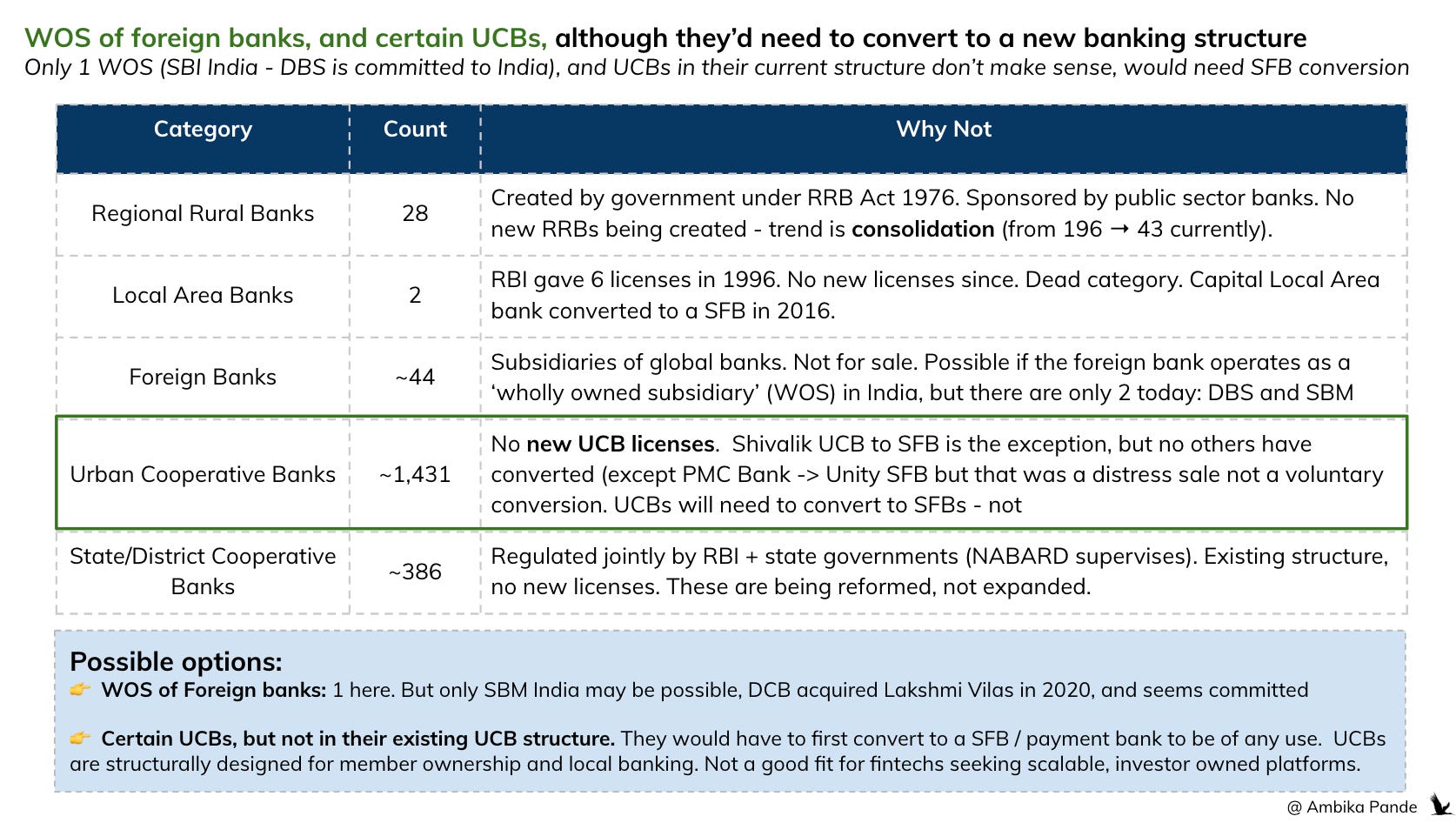
Other Categories: RRBs, Local Area Banks, Urban Cooperatives, and District Cooperatives.
1891 banks sit here. Let’s go through them one by one.
1. Regional Rural Banks (28 banks). Not Acquirable
Regional Rural Banks (RRBs) are government-backed commercial banks established under the Regional Rural Banks Act, 1976 to provide banking services and credit to rural and semi-urban India, particularly farmers, MSMEs, self-help groups and underserved communities. And Unlike private or small finance banks, every RRB has a fixed ownership structure:
50% owned by the Government of India,
35% by a sponsor bank
15% by the respective state government.
The sponsor bank is almost always a Public Sector Bank (PSB): for example, Baroda UP Bank is sponsored by Bank of Baroda, Karnataka Gramin Bank by Canara Bank, Punjab Gramin Bank by Punjab National Bank, and Tamil Nadu Grama Bank by Indian Bank. The sponsor bank provides technology, risk management, operational support and management expertise. So immediately, it doesn’t make sense for a fintech.
2. Local Area Banks (2 exist today): Dead category
Was introduced in 1996, but it never really took off. Pretty much a dead category. And there is limitation bases geography; it cannot operate across more than three districts that share borders. RBI gave 6 licenses in 2016. The Coastal Local Area Bank, and the Krishna Bhima Samruddhi Local Area Bank are still operating. And the Capital Local Area Bank converted into the Capital Small Finance Bank in 2016.
3. Foreign Banks: (44 operating, but only 2 wholly owned subsidiaries) Very tough
There are 44 foreign banks operating in India, but fintechs can only really evaluate those which are wholly owned subsidiaries. From a fintech M&A perspective, tje opportunity set is very limited:
Branch based foreign banks (HSBC, Citi, Standard Chartered, JPMorgan, Deutsche Bank, etc.) ❌ No equity to acquire.
Wholly Owned Subsidiary foreign banks (DBS India, SBM India) → ✅ In principle, equity can be sold, subject to RBI approval and the parent’s willingness. Which is what Jupiter was trying to do.
3. Urban Co-operative Banks (1431 banks sit here): Possible, and has precedence but evaluated on a case by case basis
There is precedence here, of fintech merger, or even conversion to a SFB and investment. We’ve got the BharatPe and Centrum consortium acquiring PMC Bank, to create Unity SFB. Then we also have Shivalik UCB which converted to a SFB in 2021 → it applied under RBI’s 2018 scheme allowing UCB’s to voluntarily convert to SFBs. But there are some points here.
The UCB structure will not make sense for fintechs.
A UCB isn’t owned by shareholders like a private company. It is owned by thousands (sometimes tens of thousands) of members, under the “one member, one vote” principle. UCBs are structurally designed for member ownership and local banking, making them an awkward fit for venture backed fintechs seeking scalable, investor owned banking platforms.
And Tto convert, the co-operative structure has to be replaced with a shareholder-owned banking company. That requires member approvals, legal restructuring, and RBI approval. This is much more complicated than buying an NBFC or a private bank. So any UCB that is acquired, would need to convert into some sort of private sector bank. But there is a path for this.
In 2018, the RBI introduced a formal Scheme for Voluntary Transition of Urban Co-operative Banks into Small Finance Banks.
While the RBI has created a formal pathway for Urban Co-operative Banks (UCBs) to become Small Finance Banks (SFBs), it is not a simple licence conversion. Eligible UCBs must transfer their assets and liabilities into a newly incorporated banking company, secure approval from a two-thirds majority of members under the co-operative ownership model, have a minimum net worth of INR 50 crore (along with meeting capital adequacy requirements) to qualify, and ensure the new SFB commences operations with at least ₹100 crore of capital. As a result, despite more than 1,400 UCBs in India, only a small subset are likely to have both the financial strength and governance alignment required to complete the transition.
But this UCB → SFB path isn’t easy. The RBI has consistently favoured a small number of well capitalised institutions over a large number of weak banks.
Indeed, despite the voluntary UCB to SFB pathway being available since 2018, Shivalik Small Finance Bank remains the only UCB to have completed the conversion, suggesting that the bottleneck is not regulatory permission but the limited number of institutions that are financially, operationally and governance wise capable of making the transition. And so, this number looks big: ~1431 UCBs, but only a fraction of these would probably be eligible for the ‘fintech merger / acquisition’ route.
Which brings us to the more likely candidates: SFBs and Payment Banks
Small Finance Banks and Payment Banks categories were created in 2014 by RBI. Payments Banks were created to provide infra for payments, take deposits, and allow remittances but no lending. And Small Finance Banks were created to be full service banks focused on inclusive lending to priority sectors.
Most SFBs came from MFIs and NBFCs, they were microfinance lenders who got upgraded. This is why many still carry microfinance-heavy books and struggle with asset quality diversification. The ones that successfully diversified (AU, Equitas) are pulling ahead.
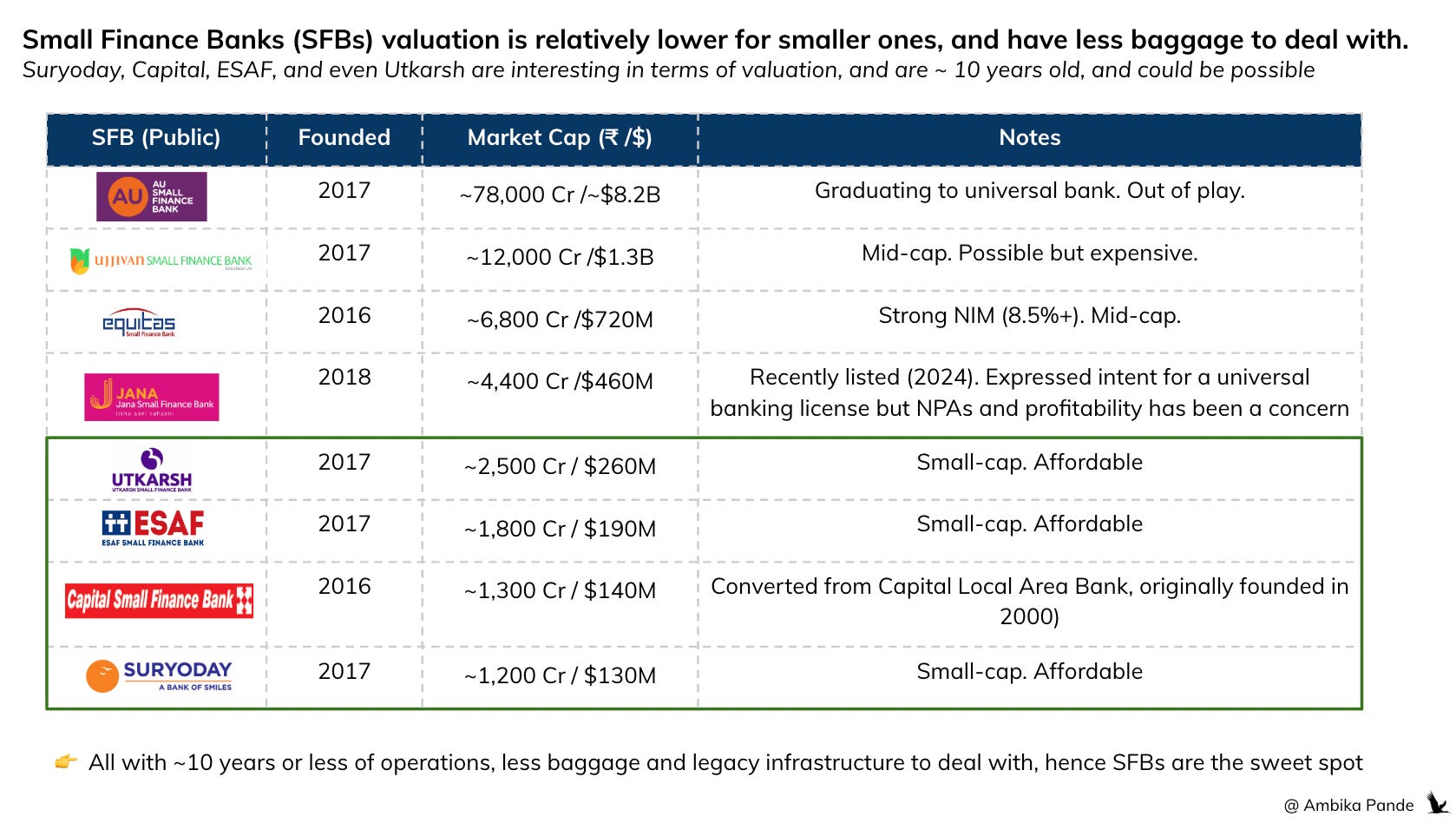
There are 11 SFBs today, out of which 8 are public, and 3 are private.
Out of the public SFBs, AU Small Finance Bank got an approval from RBI in 2025 to graduate to a Universal Banking License. And, at $8.2B it is probably way out of the fintech leagues. I’d classify both AU SFB, and Ujjivan SFB ($1.3B market cap) as probably a little too expensive.
What could be possible SFBs to consider are the < $250M and below valuation. Utkarsh, ESAF, Capital and Suryoday SFB. Jana SFB could be another, but at $460M, may be more on the expensive side.
Both Suryoday, and Jana seem to be working with fintechs: recent news suggest that they have partnered with Paytm, and other apps to provide Credit Lines on UPI.
On the private side, two are already acquired / merged with fintechs - Slice SFB, and BharatPe’s Unity SFB, leaving just Shivalik
And Shivalik has a lot of big investors on its cap table already, with Aspora being the newest one, and strengthening the fintech to bank story.
Payment Banks are another possibility - the structure is new enough to not have too much baggage. The draw back is that they cannot lend, so it limits optionality
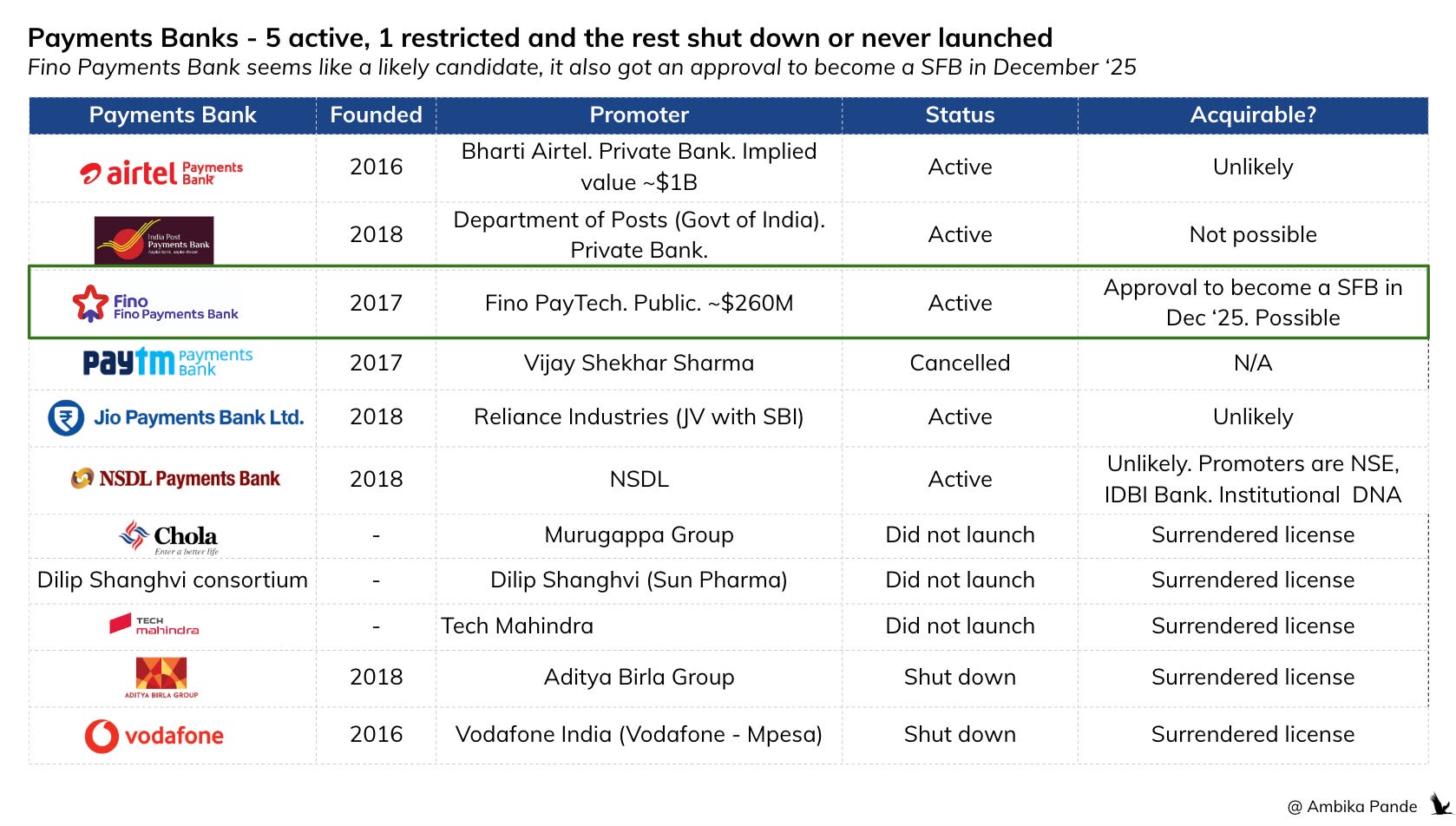
There are 5 payments banks that are active today.
Airtel Payments Bank: Part of the Airtel conglomerate
India Post Payments Bank: Government controlled
Jio Payments Bank: Part of Reliance
NSDL Payments Bank: Quasi government ownership. Meanwhile, Protean eGov acquired 4.95% in NSDL Payments Bank for ₹30.2 Cr, a DPI infrastructure play connecting to a banking entity.
Fino Payments Bank: Fino Payments Bank became the first payments bank to receive RBI’s in-principle approval to convert to an SFB (December 2025). Must complete within 18 months. Parent Fino PayTech is publicly listed, historically backed by Blackstone, Intel Capital, ICICI Group.
And Paytm’s payment bank license got cancelled in 2026.
But, of 6 licensed payments banks, only Fino is on a clear fintech relevant trajectory. Airtel, Jio, and India Post are telecom/government captives. Paytm Payments Bank is dead. But this is a small play. Only 6 payments banks in India today.
And that is why SFBs are probably the best category of banks to go after
There is a clear precedence of fintech and SFB mergers and acquisitions, with 3: Shivalik to Aspora, BharatPe and Unity SFB, and Slice SFB.
They are a new category of bank, with most being founded in the last 10 years, so they come with relatively less baggage, when you compare them to private banks, or UCBs that have been around for 30 years atleast. SFBs are 7-10 years old, not 100. No legacy unions, no century-old branch networks, no political baggage. They were built for financial inclusion with modern (or at least modernisable) tech.
Regulatory pathway. SFBs have a defined escalation ladder to universal bank status: 5-year track record → stock exchange listing → ₹1,000 Cr net worth → controlled NPAs. AU SFB is already making this transition. Slice is likely next.
Price. SFBs are more affordable. Apart from Dhanlakshmi (private bank) at $140M market cap, the rest are ~$500M+. There are 5 public SFBs less than $500M market cap, and Shivalik is at $165M valuation.
Private SFBs are even better.
There is no public market scrutiny, no SEBI takeover code triggers, no minority shareholder issues. Direct negotiation, cleaner cap table entry, path to control.
And clearly there is a global, and an Indian precedent and a trend that fintechs now, for the nextphase of growth, have to become banks.
But there’s a narrowing window for Indian fintechs, and there are limited options available
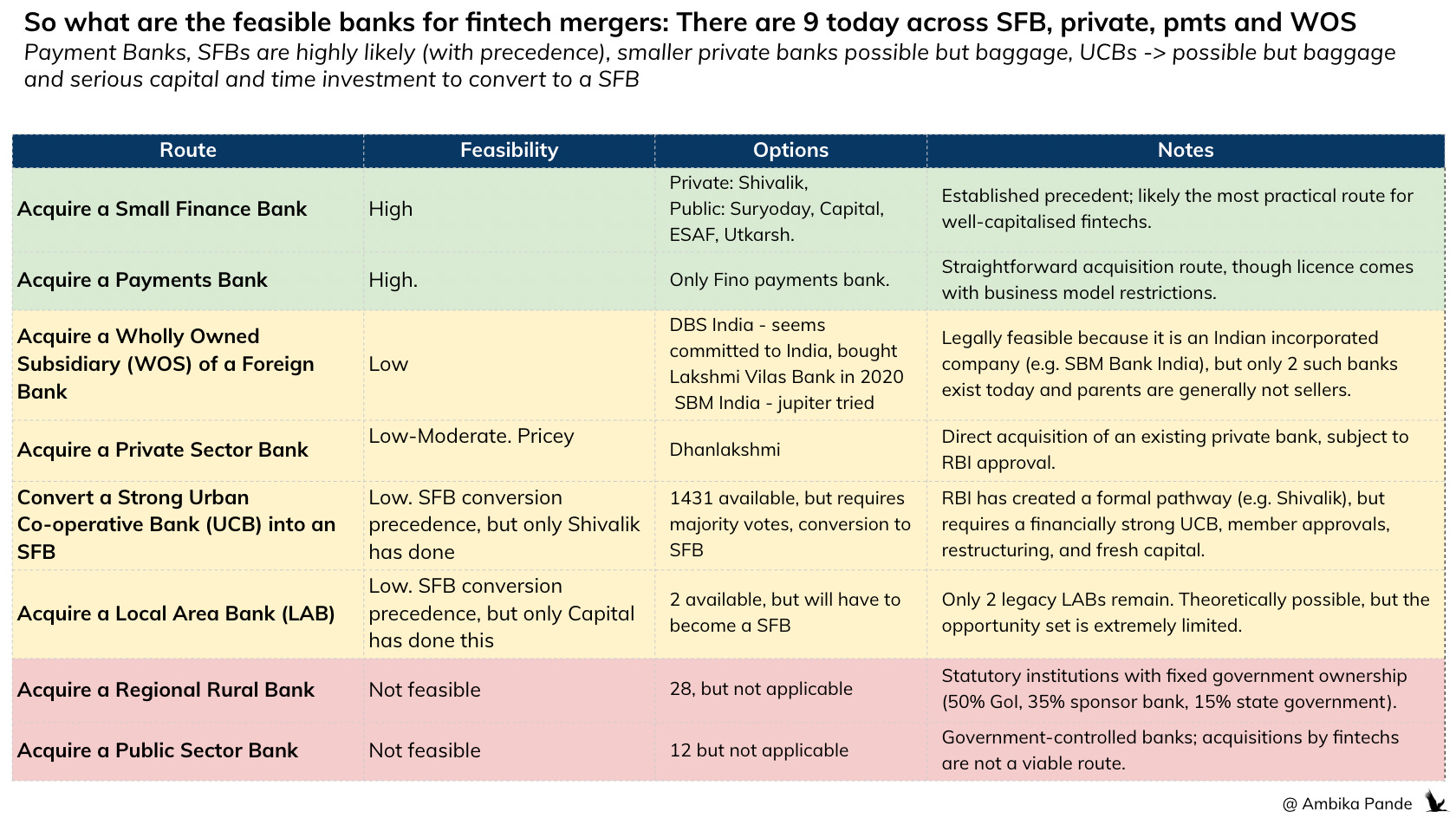
Here’s the count of what’s actually available for fintechs→ there are 9 banks today that seem possible
Those are:
Dhanlakshmi (private bank, market cap is $140M),
Fino Payments Bank (Payments bank, received approval in Dec ‘25 to transition into a SFB)
DBS India: Wholly owned Indian subsidiary of DBS.
SBM India: Wholly owned Indian subsidiary of SBM.
Shivalik: Private SFB ($165M valuation)
Suryoday: Public SFB ($130M market cap)
Capital: Public SFB ($140M market cap)
ESAF: Public SFB ($190M market cap)
Utkarsh: ($260M market cap)
The rest are either too expensive, or like the UCB / LAB banks require conversion from the existing bank structure to one that actually supports what fintechs want to do, which seems to be a SFB.
✅ SFBs remain the best route: RBI has approved fintech-SFB mergers (Slice, BharatPe) but has shown zero intent to grant de novo neobank licenses. The regulatory position is unambiguous.
Private SFBs are almost fully allocated. Shivalik is the last one standing - and with Accel, Lightspeed, SMBC, and now Aspora in the cap table, the next move is likely a controlling stake by a fintech or a consortium, not another minority position.
The listed SFB market is where the next wave happens. Small-cap listed SFBs Expect block deals, open offers, and creeping acquisitions from well-funded fintechs. 8 total. 1 graduating out (AU). Of the remaining 7, the affordable ones listed above offer the most realistic entry points, but come with public market complexity.
✅ WOS: This is possible, and what Jupiter was going for with SBM india.
✅ Payments Banks: Airtel - no. Jio - no. India Post - no. NSDL - unlikely. Remaining. Fino payments bank. Possible, since it got a SFB.
⚠️ Old private banks remain a dark horse. If a fintech with deep pockets (or a PE fund with fintech ambitions) can stomach the integration complexity, Dhanlaxmi ($140M) offers full commercial bank licenses at SFB like valuation, skipping the SFB→universal bank graduation entirely. But nobody has attempted this yet for a reason. And DCB seems committed to India, they acquired Lakshmi Vilas Bank in 2020, via a distressed sale.
⚠️ Urban Cooperatives: On their own co-operative banks don’t help fintechs, so they would need to convert, ideally to a SFB. And there is precedence for conversion - PMC Bank and Shivalik UCB. But, the RBI mandated the UCB to SFB conversion in 2018. In the last 8 years, only Shivalik has done it. Shivalik converting seems to be the exception, not the rule
The RBI seems to have, through approvals, charted out a path for the fintech to bank merger / acquisition. And the global pattern confirms it, this is where fintechs are headed.
The only variable is how many banking licenses are left to acquire, and that number is shrinking fast.