
[#90] Why (WhAI): The cost of constant optimization, and why I still take notes by hand
As AI removes friction from work, we may also be removing the mental warm ups that help us think, reflect, and build momentum. Some things should not be fully automated.

Every week there's a new story about AI automating workflows. About using AI but making it sound like it's not AI. And this isn't a criticism on AI - I use it too. Like everyone else, I’ve been experimenting with AI too. I’ve built prototypes, used the tools, figured out where they help. I’ve used it for summarizing articles, and as a brainstorming partner.
But the work we're rushing to automate is where I realized that my brain quietly does its best thinking
But here’s the thing: that work that we’re automating away? It’s really important to the process.
Firstly, what I realized is that I like creating. I like writing things out. I like replying to emails. I want the people I’m speaking with to know it’s actually me responding, and not an automated mail or message sent without a second thought. I like building slides, writing documents, and going through the process of putting thoughts together. I don’t want to automate all this away. A lot of the “manual” work people want to automate away is where my brain quietly does its best thinking.
The problem with automating everything is that it puts a strange amount of pressure on the brain. If every low friction task disappears, all that remains is the high stakes work. The hard thinking, the ambiguity, the things that do not resolve immediately. There’s no gradual ramp into difficult work anymore. No small wins. No sense of “I finished something.” Just constant cognitive strain. When I was training professionally, warm ups were essential for two reasons. The obvious one was injury prevention. You do not go into an intense effort cold. But the second was that performance itself improves gradually. It takes time for the muscles to warm up. One workout we used to do was 400m repeats. During timed sessions or fitness tests, the second or third repeat was often the fastest, not the first, because by then the body had fully engaged. The earlier laps were not wasted effort. They were part of the process of reaching peak performance.
AI automation is increasingly removing those warm up laps. Automation eliminates the small, low friction tasks that used to help people build momentum. So instead of easing into complexity, you are dropped directly into cognitively demanding work every time. Imagine if every run you ever did was treated like a race. No warm up jog, or gradual build up, just maximum effort from the first second. You would probably underperform more often, fatigue faster, and eventually lose morale. The same thing can happen mentally when every task becomes high stakes by default.
And ironically, some of my best ideas arrive while I’m doing those lower stakes tasks. Those tasks are what enable me to perform better
When I’m formatting slides or writing notes. Or even summarizing something manually is when my brain is partially on autopilot are when those connections happen. Everything today seems designed around efficiency. Faster writing. Faster summaries. Faster meetings. Faster thinking. But deep thinking rarely happens at speed. It happens when I’m sitting with an idea for a while. It happens when I’m reading something carefully, re-reading a paragraph, opening five tabs, cross checking details, or manually piecing together information. Even simple information collation has value when you do it yourself, because that’s how ideas start connecting.
There’s a reason people talk about the connection between the mind and the hand. Research consistently shows that handwriting improves memory formation, conceptual understanding, and learning retention compared to typing. Writing by hand forces your brain to process information differently. You have to first interpret the incoming information, you then have to summarize it, compress it in a way that makes sense to you, and then put it together in a way that you can apply it to other concepts. Because it is impossible to write everything down; you have to actively pay attention to the information and process it, prioritize it, consolidate it and try to relate it to things you’ve learned before. Immediately, you’re processing information in a way that you can understand and retain.
For me, writing notes by hand is far more effective than typing because the friction forces you to sit with an idea, but once AI starts transcribing, summarizing, and reviewing everything for you, you’re not spending time to really think through what you just consumed.
I’m a great believer of taking notes by hand. In fact, I still take notes by hand. When I’m trying to understand a concept or work through an idea, I use a notebook. I take notes, cross them off, draw diagrams, and then while zoning out, doodle on the corners of the page. But that’s where things really assimilate for me. That’s where I remember things. AI makes many things easier. I use it too. But easier and better are not always the same thing.
And to be fair, there are places where AI is genuinely useful. Large dumps of information, sorting through unstructured data, identifying patterns humans would miss at scale, that’s where these systems shine. Bajaj Finance, for example, spoke about using AI systems to analyse millions of customer calls, convert voice to text, identify patterns, and generate over 100,000 new loan offers and INR 1,600 crore worth of loan disbursals through AI-assisted workflows.
That’s all fair. At that scale, no human team can manually process that volume of information fast enough. But even then, I still think there’s value in going through customer feedback yourself. When you’re reading things line by line, seeing the phrasing people use, and the context around what they’re saying, that is truly what drives understanding. AI can surface patterns sure. But understanding people still requires spending time with the raw material yourself. And honestly, for a lot of leaders constantly talking about “AI replacing work,” coding was never actually the job in the first place. The job was thinking.
It was about finding the best solution to a problem. It was about understanding tradeoffs. Figuring out customer behavior, and designing systems. It was about making decisions under ambiguity. Coding, slides, documents, those were implementation layers.
I can spin up a prototype too. I can build internal tools. AI absolutely democratizes prototyping and experimentation. That’s genuinely powerful. But is it the best architecture or the most elegant code? Is it secure? Is it the most scalable solution? My guess is probably not. So the problem isn’t automating implementation. It was never automating implementation.
The problem is what happens to your brain when you automate away the process of struggle itself. An interesting idea I came across recently is “time under strain.” In strength training, growth happens because your muscles spend time under resistance. The strain itself is what creates adaptation. Thinking works similarly. The time spent wrestling with an idea, reading the original source, manually connecting dots, struggling through ambiguity, that’s where understanding forms. Remove all the friction, and sometimes you also remove the depth.
There’s also another thing I think we underestimate: boredom and idle cognition.
Some of the best ideas emerge during repetitive or low-focus activity. Neuroscience research around the brain’s “default mode network” suggests that creativity and insight often emerge when the mind is wandering, rather than when it is hyper-optimized toward output. That’s part of what worries me about automating everything away.
A lot of “manual” work creates mental “space.” What I mean by this is: it gives your brain space to wander in the background, while you’re doing work that doesn’t require too much cognitive effort. And that’s when the magic happens. For example, for my own deep dives, I still make all my slides by hand. Because that is a low stakes way for me to engage with the information, while subconsciously I make connections about things I didn’t before, which often gives me a new perspective, or a new angle to write about. When you do repetitive tasks while your brain chills in the background, while those moments often look unproductive externally, internally that’s where unexpected connections form. When every layer of work gets automated into instant outputs, summaries, and one click generation, you lose some of that space too.
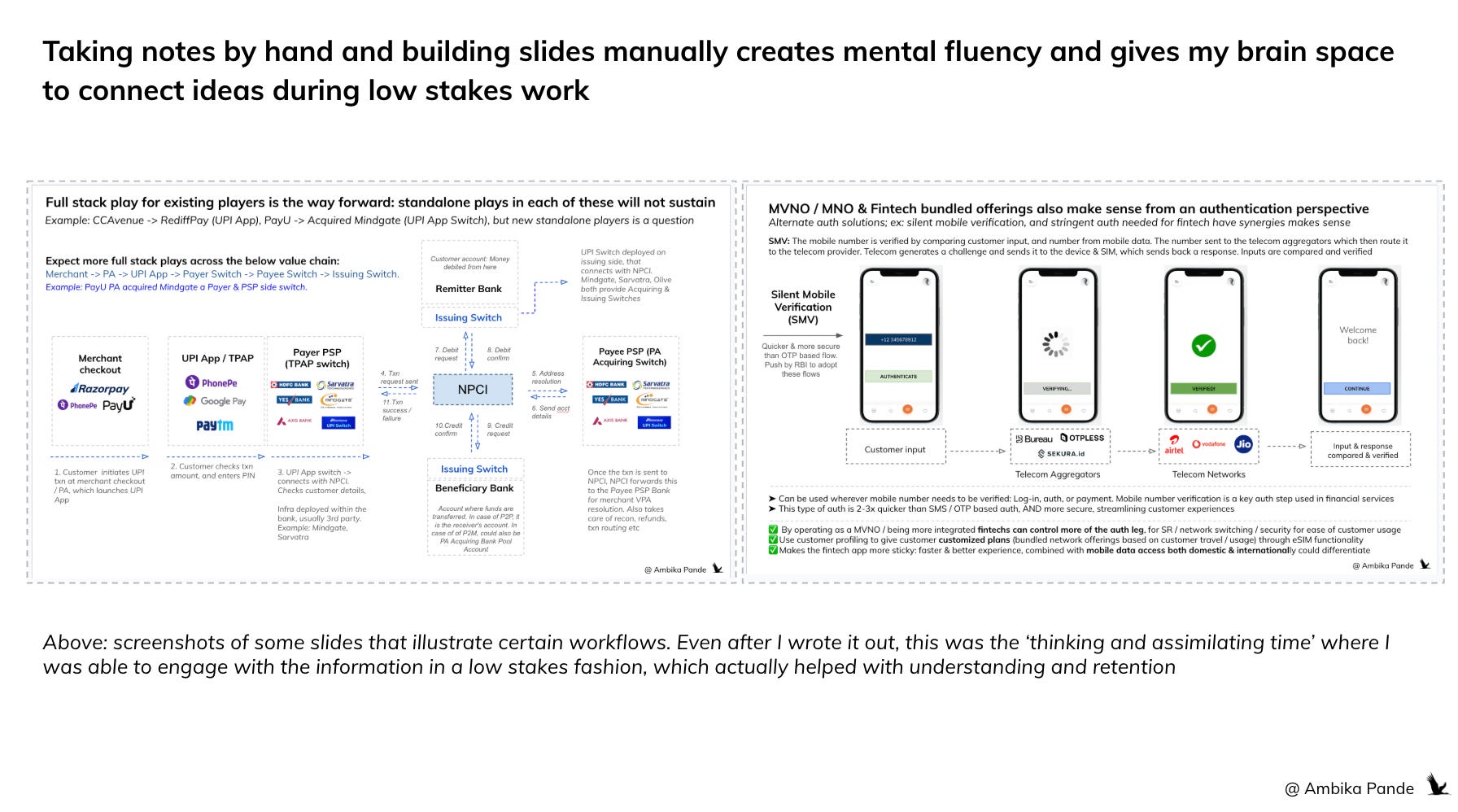
When AI tools exploded, I naturally tried using them for research workflows. And yes, they helped. At least, that’s what I thought at the start.
But I found two problems.
The first is obvious: hallucinations. AI can confidently present things that are incorrect or partially wrong. There are ways to reduce this, and if you’re not verifying outputs yourself, that is just silly. But the second issue mattered more to me.
When I write, I’m not just trying to ship an article, or put together a document just for the ‘sake of it.’ This is my thinking time. It’s when I learn something new, or get clarity on certain things that I want to build, or even put a strategic perspective together. I enjoy the process of forming a hypothesis, reading the fine print, discovering unexpected details, and slowly arriving at a conclusion.
With AI, I had the same information collated into a neat document. But it didn’t really sit in my head. And yes, I know the counterargument: “Use AI to gather information, then review it yourself.” Or “AI has turned you from a doer into a reviewer.” All fair points. But that still isn’t the same thing. Reading every detail manually forces you to notice patterns. You remember edge cases. You stumble onto unrelated ideas. You build intuition. The process itself shapes the outcome. Sure, I had the research. But even after reviewing it, I felt poorer for skipping the journey that produced understanding in the first place.
AI is an amazing learning tool. But time under strain matters. And if you automate all of that away, I think you’ll be lesser for it. I’m not anti AI. Far from it. I think these tools are genuinely transformative. Everyone will use them, and so will I. But I also think there’s value in preserving parts of the process that make us think more deeply, even if they’re slower.
So yes, I’ll probably automate some things away. But I’ll still write notes by hand. I’ll still build my own slides. I’ll still read original papers and source documents myself. I’ll still spend time thinking through problems manually. And maybe that makes me “less productive” than someone who automates everything away. My “work done by AI” stats may be lower. A requirements document that takes someone two days with AI might take me a week. But that’s fine.
Because sometimes the point of the work isn’t just the output. It’s what the process of work does to your mind and the final output while you’re doing it.